Showing posts with label memorial. Show all posts

2012/09/12

Rice Unverisity - 50 years

This is the speech President John F. Kennedy gave at Rice University 50 years ago today.  I point this out mainly because I morphed a quotation from it into my Orbiter motto.  Also, because he touched upon the idea of American exceptionalism...a quaint idea that has fallen by the wayside since.

Full credit to the John F. Kennedy Presidential Library.

Added emphasis is mine.

President Pitzer, Mr. Vice President, Governor, Congressman Thomas, Senator Wiley, and Congressman Miller, Mr. Webb, Mr. Bell, scientists, distinguished guests, and ladies and gentlemen:
     I appreciate your president having made me an honorary visiting professor, and I will assure you that my first lecture will be very brief.
     I am delighted to be here and I'm particularly delighted to be here on this occasion.
     We meet at a college noted for knowledge, in a city noted for progress, in a State noted for strength, and we stand in need of all three, for we meet in an hour of change and challenge, in a decade of hope and fear, in an age of both knowledge and ignorance. The greater our knowledge increases, the greater our ignorance unfolds.
     Despite the striking fact that most of the scientists that the world has ever known are alive and working today, despite the fact that this Nation¹s own scientific manpower is doubling every 12 years in a rate of growth more than three times that of our population as a whole, despite that, the vast stretches of the unknown and the unanswered and the unfinished still far outstrip our collective comprehension.
     No man can fully grasp how far and how fast we have come, but condense, if you will, the 50,000 years of man¹s recorded history in a time span of but a half a century. Stated in these terms, we know very little about the first 40 years, except at the end of them advanced man had learned to use the skins of animals to cover them. Then about 10 years ago, under this standard, man emerged from his caves to construct other kinds of shelter. Only five years ago man learned to write and use a cart with wheels. Christianity began less than two years ago. The printing press came this year, and then less than two months ago, during this whole 50-year span of human history, the steam engine provided a new source of power.
     Newton explored the meaning of gravity. Last month electric lights and telephones and automobiles and airplanes became available. Only last week did we develop penicillin and television and nuclear power, and now if America¹s new spacecraft succeeds in reaching Venus, we will have literally reached the stars before midnight tonight.
     This is a breathtaking pace, and such a pace cannot help but create new ills as it dispels old, new ignorance, new problems, new dangers. Surely the opening vistas of space promise high costs and hardships, as well as high reward.
     So it is not surprising that some would have us stay where we are a little longer to rest, to wait. But this city of Houston, this State of Texas, this country of the United States was not built by those who waited and rested and wished to look behind them. This country was conquered by those who moved forward--and so will space.
     William Bradford, speaking in 1630 of the founding of the Plymouth Bay Colony, said that all great and honorable actions are accompanied with great difficulties, and both must be enterprised and overcome with answerable courage.
     If this capsule history of our progress teaches us anything, it is that man, in his quest for knowledge and progress, is determined and cannot be deterred. The exploration of space will go ahead, whether we join in it or not, and it is one of the great adventures of all time, and no nation which expects to be the leader of other nations can expect to stay behind in the race for space.
     Those who came before us made certain that this country rode the first waves of the industrial revolutions, the first waves of modern invention, and the first wave of nuclear power, and this generation does not intend to founder in the backwash of the coming age of space. We mean to be a part of it--we mean to lead it. For the eyes of the world now look into space, to the moon and to the planets beyond, and we have vowed that we shall not see it governed by a hostile flag of conquest, but by a banner of freedom and peace. We have vowed that we shall not see space filled with weapons of mass destruction, but with instruments of knowledge and understanding.
     Yet the vows of this Nation can only be fulfilled if we in this Nation are first, and, therefore, we intend to be first. In short, our leadership in science and in industry, our hopes for peace and security, our obligations to ourselves as well as others, all require us to make this effort, to solve these mysteries, to solve them for the good of all men, and to become the world's leading space-faring nation.
     We set sail on this new sea because there is new knowledge to be gained, and new rights to be won, and they must be won and used for the progress of all people. For space science, like nuclear science and all technology, has no conscience of its own. Whether it will become a force for good or ill depends on man, and only if the United States occupies a position of pre-eminence can we help decide whether this new ocean will be a sea of peace or a new terrifying theater of war. I do not say the we should or will go unprotected against the hostile misuse of space any more than we go unprotected against the hostile use of land or sea, but I do say that space can be explored and mastered without feeding the fires of war, without repeating the mistakes that man has made in extending his writ around this globe of ours.
     There is no strife, no prejudice, no national conflict in outer space as yet. Its hazards are hostile to us all. Its conquest deserves the best of all mankind, and its opportunity for peaceful cooperation many never come again. But why, some say, the moon? Why choose this as our goal? And they may well ask why climb the highest mountain? Why, 35 years ago, fly the Atlantic? Why does Rice play Texas?
     We choose to go to the moon. We choose to go to the moon in this decade and do the other things, not because they are easy, but because they are hard, because that goal will serve to organize and measure the best of our energies and skills, because that challenge is one that we are willing to accept, one we are unwilling to postpone, and one which we intend to win, and the others, too.
     It is for these reasons that I regard the decision last year to shift our efforts in space from low to high gear as among the most important decisions that will be made during my incumbency in the office of the Presidency.
     In the last 24 hours we have seen facilities now being created for the greatest and most complex exploration in man's history. We have felt the ground shake and the air shattered by the testing of a Saturn C-1 booster rocket, many times as powerful as the Atlas which launched John Glenn, generating power equivalent to 10,000 automobiles with their accelerators on the floor. We have seen the site where five F-1 rocket engines, each one as powerful as all eight engines of the Saturn combined, will be clustered together to make the advanced Saturn missile, assembled in a new building to be built at Cape Canaveral as tall as a 48 story structure, as wide as a city block, and as long as two lengths of this field.
     Within these last 19 months at least 45 satellites have circled the earth. Some 40 of them were "made in the United States of America" and they were far more sophisticated and supplied far more knowledge to the people of the world than those of the Soviet Union.
     The Mariner spacecraft now on its way to Venus is the most intricate instrument in the history of space science. The accuracy of that shot is comparable to firing a missile from Cape Canaveral and dropping it in this stadium between the the 40-yard lines.
     Transit satellites are helping our ships at sea to steer a safer course. Tiros satellites have given us unprecedented warnings of hurricanes and storms, and will do the same for forest fires and icebergs.
     We have had our failures, but so have others, even if they do not admit them. And they may be less public.
     To be sure, we are behind, and will be behind for some time in manned flight. But we do not intend to stay behind, and in this decade, we shall make up and move ahead.
     The growth of our science and education will be enriched by new knowledge of our universe and environment, by new techniques of learning and mapping and observation, by new tools and computers for industry, medicine, the home as well as the school. Technical institutions, such as Rice, will reap the harvest of these gains.
     And finally, the space effort itself, while still in its infancy, has already created a great number of new companies, and tens of thousands of new jobs. Space and related industries are generating new demands in investment and skilled personnel, and this city and this State, and this region, will share greatly in this growth. What was once the furthest outpost on the old frontier of the West will be the furthest outpost on the new frontier of science and space. Houston, your City of Houston, with its Manned Spacecraft Center, will become the heart of a large scientific and engineering community. During the next 5 years the National Aeronautics and Space Administration expects to double the number of scientists and engineers in this area, to increase its outlays for salaries and expenses to $60 million a year; to invest some $200 million in plant and laboratory facilities; and to direct or contract for new space efforts over $1 billion from this Center in this City.
     To be sure, all this costs us all a good deal of money. This year¹s space budget is three times what it was in January 1961, and it is greater than the space budget of the previous eight years combined. That budget now stands at $5,400 million a year--a staggering sum, though somewhat less than we pay for cigarettes and cigars every year. Space expenditures will soon rise some more, from 40 cents per person per week to more than 50 cents a week for every man, woman and child in the United Stated, for we have given this program a high national priority--even though I realize that this is in some measure an act of faith and vision, for we do not now know what benefits await us. But if I were to say, my fellow citizens, that we shall send to the moon, 240,000 miles away from the control station in Houston, a giant rocket more than 300 feet tall, the length of this football field, made of new metal alloys, some of which have not yet been invented, capable of standing heat and stresses several times more than have ever been experienced, fitted together with a precision better than the finest watch, carrying all the equipment needed for propulsion, guidance, control, communications, food and survival, on an untried mission, to an unknown celestial body, and then return it safely to earth, re-entering the atmosphere at speeds of over 25,000 miles per hour, causing heat about half that of the temperature of the sun--almost as hot as it is here today--and do all this, and do it right, and do it first before this decade is out--then we must be bold.
     I'm the one who is doing all the work, so we just want you to stay cool for a minute. [laughter]
     However, I think we're going to do it, and I think that we must pay what needs to be paid. I don't think we ought to waste any money, but I think we ought to do the job. And this will be done in the decade of the sixties. It may be done while some of you are still here at school at this college and university. It will be done during the term of office of some of the people who sit here on this platform. But it will be done. And it will be done before the end of this decade.
     I am delighted that this university is playing a part in putting a man on the moon as part of a great national effort of the United States of America.
     Many years ago the great British explorer George Mallory, who was to die on Mount Everest, was asked why did he want to climb it. He said, "Because it is there."
     Well, space is there, and we're going to climb it, and the moon and the planets are there, and new hopes for knowledge and peace are there. And, therefore, as we set sail we ask God's blessing on the most hazardous and dangerous and greatest adventure on which man has ever embarked.
     Thank you.

2012/08/26

One Small Step

Resquiescat in pace, and ad astra per perspira!
 
 
Photo credit: Donamy

Oh! I have slipped the surly bonds of earth,
And danced the skies on laughter-silvered wings;
Sunward I’ve climbed, and joined the tumbling mirth
Of sun-split clouds, –and done a hundred things
You have not dreamed of –Wheeled and soared and swung
High in the sunlit silence. Hov’ring there
I’ve chased the shouting wind along, and flung
My eager craft through footless halls of air…
Up, up the long, delirious, burning blue
I’ve topped the wind-swept heights with easy grace
Where never lark or even eagle flew —
And, while with silent lifting mind I’ve trod
The high untrespassed sanctity of space,
Put out my hand, and touched the face of God.

John Gillespie Magee, Jr


Since Neil was initially trained as a Naval aviator, he also deserves a Missing Man:


Photo credit: Star Voyager


Now for the really boring part, Dear Reader (if any).  I still remember watching the first "small step" live on TV.  I was watching it with my father (another boyhood hero who is now gone), and he was trimming my fingernails.

UPDATED SEPTEMBER 1, 2012:


Missing Man formation flown for Neil at his memorial on August 31, 2012:


Photo Credit: NASA


Then there was two:


Photo Credit: NASA


2011/11/11

Veterans Day

Today, it has the added distinction of being all binary (11/11/11).  But only if an artificial date format is used.  I could post this at the 11th hour today too, in remembrance of the original proclamation.

Since 2000, one veteran I never fail to remember this day is my father Allen.  He died the day after his 75th birthday that year.  He served as a crew member with a B-24 Liberator bomb group assigned to protect the Canal Zone (Panama Canal) during World War 2.

Ironically, the only action he ever saw was, "while on patrol east of the Canal, they saw a dark shape under the water, but by the time they circled around for a 2nd pass, it had disappeared."  Had to be a German U-Boat.

While at the mortuary making the funeral arrangements, I was the only child to remember the last honor promised to him by, "a grateful nation".  I asked my brother Paul (who also served with me in the US Navy), who should receive the flag...he deferred that honor to me.


I do miss him, but I do have the sure knowledge of seeing him again.  Reference I Thessalonians 4:13-18.

What actually inspired this post was the following YouTube video:


In closing, the difference between Thanksgiving and Veterans Day:


If you can read this thank a teacher...


If you can read this in English, thank a Veteran.

2011/07/30

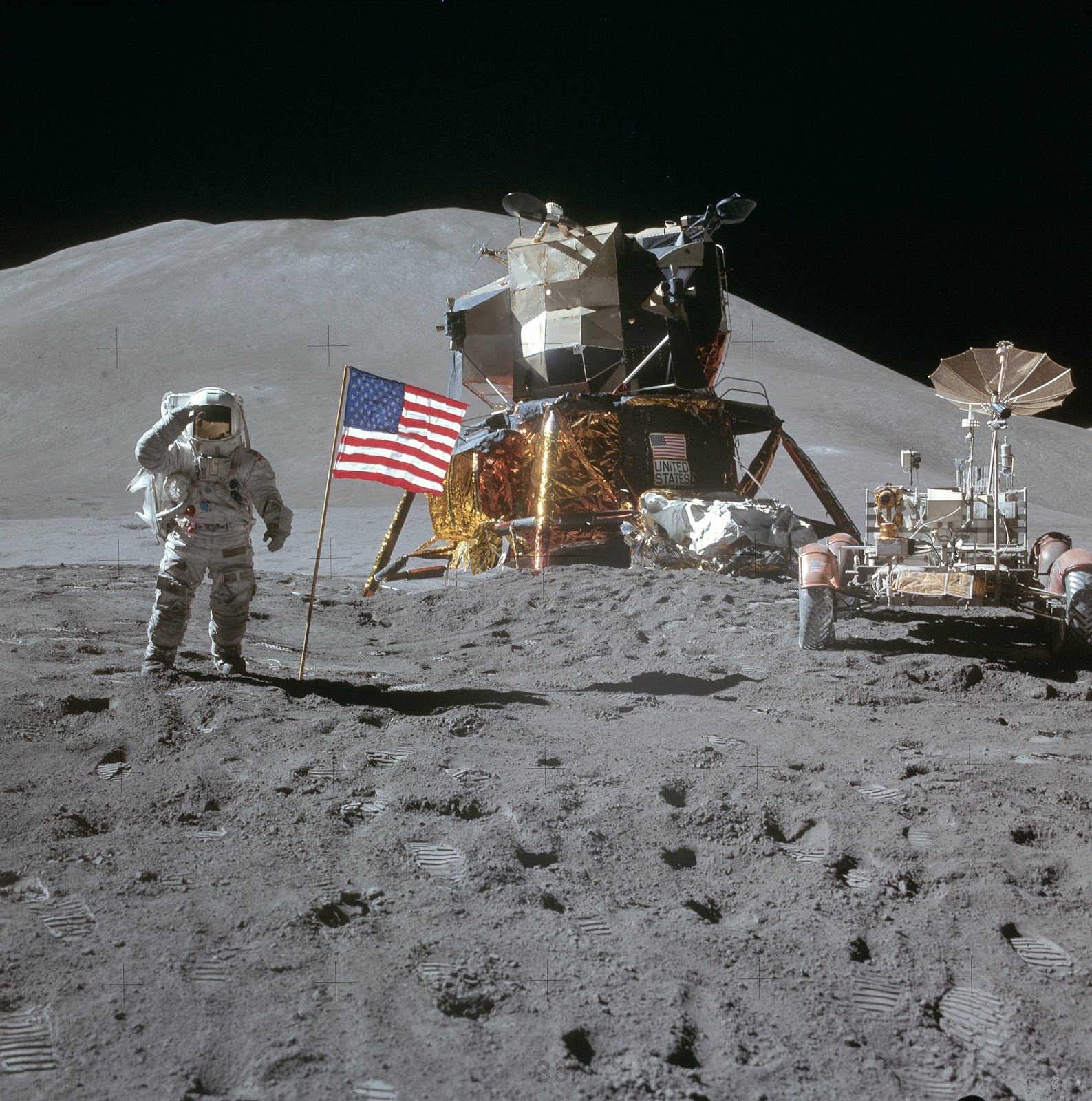
Apollo 15 - 40 years

Yes, it is anniversary announcement time again.

Apollo 15 flew 40 years ago, from July 26, 1971 to August 7, 1971.  It still remains my favorite mission of the Apollo series - and my scenario pack for this mission was my first Orbiter add-on.
It was the only mission I witnessed on TV from beginning to end.  That was because it happened in the summer during school break between 3rd and 4th grades.

This date mission event was lunar landing at 6:16:29 PM EDT on July 30, 1971.

Mission firsts:
  • First mission to use the Lunar Rover.
  • First and only mission to incorporate a SEVA (Standing Extra Vehicular Activity).
  • First mission to demonstrate a "Mr. Wizard" moment, i.e., dropping of the hammer and feather in vacuum.
  • First all Air Force derived crew
  • First deployment of a satellite while in lunar orbit.
  • First EVA performed between Earth and Moon.
  • First and only graduate of East High School (in SLC, UT) to walk on the Moon.  See photo below.
Courtesy of NASA.  Photo of Jim Irwin saluting the flag.

Jim Irwin remains the only astronaut I've seen in person.  He visited his high school alma mater to speak to the student body.

2011/05/05

50 Years of American Spaceflight


Today marks the 50th anniversary of Alan B. Shepard's sub-orbital flight aboard Freedom 7.  The "ride" only lasted 15 minutes and 22 seconds, and reached a height of 116.46 miles.  As his flight was the first to follow international rules, I decided not to mention in this blog the one that happened about 3 weeks earlier.  OK, I'll admit I'm biased...the earlier flight wasn't American.  Freedom 7 had been scheduled to fly 1 month earlier, but NASA wanted to perform more testing (yes, that's right, we sent another chimp up first), thus losing another round in the Space Race.

Yesterday, the U.S. Postal Service released two new stamps commemorating 2 flights spanning this time period.  Shepard is the first astronaut to appear by himself on a stamp:


This video from NASA honors today's achievement, and includes comments from 2 of his Mercury colleagues:


Shepard was the only astronaut of the original seven selected by NASA to go on and make a moon landing as commander of Apollo 14.  He also was the first to play golf on the Moon, on Feb. 6, 1971 (my ninth birthday).


 Miles and miles and miles...

2011/02/01

In Remembrance: STS-107 (Columbia)

February 1, 2003  8 years ago.
Rick Husband

William McCool

Kalpana Chawla

Laurel Clark

David Brown

Michael Anderson

Ilan Ramon (Israel's 1st astronaut)
 Later that day, George W. Bush addressed the nation from the Oval Office.  He said, in part:
In the skies today we saw destruction and tragedy. Yet farther than we can see there is comfort and hope. In the words of the prophet Isaiah, "Lift your eyes and look to the heavens. Who created all these? He who brings out the starry hosts one by one and calls them each by name. Because of His great power and mighty strength, not one of them is missing."
The same Creator who names the stars also knows the names of the seven souls we mourn today. The crew of the shuttle Columbia did not return safely to Earth; yet we can pray that all are safely home.

2011/01/28

In Remembrance: STS-51L (Challenger)

January 28, 1986  25 years ago.


Dick Scobee

Mike Smith

Ron McNair

Ellison S. Onizuka

Greg Jarvis

Judy Resnik

Sharon Christa McAuliffe
 Later that day, Ronald Reagan gave this eulogy from the Oval Office:
Nineteen years ago, almost to the day, we lost three astronauts in a terrible accident on the ground. But, we've never lost an astronaut in flight; we've never had a tragedy like this. And perhaps we've forgotten the courage it took for the crew of the shuttle; but they, the Challenger Seven, were aware of the dangers, but overcame them and did their jobs brilliantly. We mourn seven heroes: Michael Smith, Dick Scobee, Judith Resnik, Ronald McNair, Ellison Onizuka, Gregory Jarvis, and Christa McAuliffe. We mourn their loss as a nation together.

For the families of the seven, we cannot bear, as you do, the full impact of this tragedy. But we feel the loss, and we're thinking about you so very much. Your loved ones were daring and brave, and they had that special grace, that special spirit that says, 'Give me a challenge and I'll meet it with joy.' They had a hunger to explore the universe and discover its truths. They wished to serve, and they did. They served all of us.

We've grown used to wonders in this century. It's hard to dazzle us. But for twenty-five years the United States space program has been doing just that. We've grown used to the idea of space, and perhaps we forget that we've only just begun. We're still pioneers. They, the members of the Challenger crew, were pioneers.

And I want to say something to the schoolchildren of America who were watching the live coverage of the shuttle's takeoff. I know it is hard to understand, but sometimes painful things like this happen. It's all part of the process of exploration and discovery. It's all part of taking a chance and expanding man's horizons. The future doesn't belong to the fainthearted; it belongs to the brave. The Challenger crew was pulling us into the future, and we'll continue to follow them...

There's a coincidence today. On this day 390 years ago, the great explorer Sir Francis Drake died aboard ship off the coast of Panama. In his lifetime the great frontiers were the oceans, and a historian later said, 'He lived by the sea, died on it, and was buried in it.' Well, today we can say of the Challenger crew: Their dedication was, like Drake's, complete.

The crew of the space shuttle Challenger honoured us by the manner in which they lived their lives. We will never forget them, nor the last time we saw them, this morning, as they prepared for the journey and waved goodbye and 'slipped the surly bonds of earth' to 'touch the face of God.'

High Flight — John Gillespie Magee, Jr

Oh! I have slipped the surly bonds of Earth
And danced the skies on laughter-silvered wings;
Sunward I’ve climbed, and joined the tumbling mirth
Of sun-split clouds, — and done a hundred things
You have not dreamed of — wheeled and soared and swung
High in the sunlit silence. Hov’ring there,
I’ve chased the shouting wind along, and flung
My eager craft through footless halls of air. . . .
Up, up the long, delirious burning blue
I’ve topped the wind-swept heights with easy grace
Where never lark, or ever eagle flew —
And, while with silent, lifting mind I’ve trod
The high untrespassed sanctity of space,
Put out my hand, and touched the face of God.

2011/01/27

In Remembrance: Apollo 1

January 27, 1967.  44 years ago.

Virgil I. "Gus" Grissom

Edware H. White II

Roger B. Chafee

The memorial plaque reads, in part,

Ad astra per aspera (a rough road leads to the stars)

God speed to the crew of Apollo 1

2010/05/08

I wonder where Guenter Wendt?

Guenter Wendt, a Space Age icon, died on Monday, May 3, 2010.  I reference the old joke only to pay tribute.


Much has been said already in the press about the man since his death. See NASA's official press release here.  And 2 YouTube entries, here and here.

What I haven't seen yet is what I believe is the origin of the joke, as referenced above in the title.

As seen in the HBO mini series, From the Earth to the Moon, in the episode titled, "We Have Cleared the Tower" (which chronicles the flight of Apollo 7, the first manned Apollo mission) about 49 minutes into the episode, the following dialogue takes place:

Cunningham: So quiet.

Eisele: Yeah...I wonder where Guenter Wendt?

(Entire Apollo 7 crew laughs)

Schirra: (Still laughing)  I'm gonna steal that!

Guenter actually has a cameo role in the same episode.  At about 27 minutes into it, you see the camera panning right as you hear Mark Harmon (portraying Wally Schirra) speaking about the flight plan. Guenter is seated at the table to Mark Harmon's left.

Tom Hanks, portraying Apollo 13's Jim Lovell, quotes the same line while in the process of suiting up.

Being a born-again Christian, and not knowing Mr. Wendt's standing with Christ, I truly wonder where he went.

R.I.P.

2008/02/24

Tribute to Dennis Hare, "LazyD"


I never met the man. I really wish to have had the chance to communicate with Dennis.

But he did have a HUGE impact on my life - my Orbiter life, that is.

The first time I used LandMFD, I thought it was only for Orbiter ver 050216. I struggled to do landings manually with add-ons written for Orbiter ver 060504. Then I discovered in the forums that LandMFD would work for the newer version. Also discovered what a newbie I really was.

Then about a year later, AMSO (Apollo Mission Simulator for Orbiter) comes to my attention. With Dennis' autopilots available, many difficult Apollo maneuvers became effortless. This was the inspirational basis for development of my Apollo 15 scenario pack. It really would have been more difficult, both to me and those who are new to Orbiter, to use ANY scenarios if Dennis had not done such outstanding work on the autopilots.

Not 2 months later came the sad news from Alain Capt (AKA ACSoft): Dennis Hare had passed on. By this time, I had learned enough to publish REAL add-ons for Orbiter. There was mention of a contest for memorials and tributes in the M6 forum. So I gave it a shot.

The first time I encountered his Orbiter "name", cattle brands and cattle ranching popped into my mind. Tschachim shared with me the following link:
http://www.ibiblio.org/mscorbit/mscforum/index.php?topic=136.msg2273#msg2273
which turned out to be a confirmation of his Orbiter "name", and a wonderful insight into the man's personal life. The relevent excerpt follows:
Coussini & Cale,

I sent new modules to Joe, he seems to be able to get them. Maybe he will be kind enough to send them along to you. Sorry I haven't gotten these to you - I'm spending my days catching cattle and hauling them away in a trailer - that's life on the LazyD ranch.

The letter "D" on its side, to me, conveys a sense of rest. I used this idea as the starting point for my tribute. Plus I knew it would be really easy to model. I choose the lunar Hadley-Apennines as the location because I too like the idea of "exploring beautiful places". I placed it near the crater Rhysling because I'm a fan of the sci-fi author Robert A. Heinlein. A song written by Heinlein's character of Rhysling appears in part on the memorial plaque.

And now the pictures. Click on any of them to enlarge:


This one was a preliminary: it shows version #1 of the plaque and a suited figure I was using for scale.


The final version:


In closing, I would like to express my sympathy for your loss.