Showing posts with label space. Show all posts
Showing posts with label space. Show all posts
2014/03/09
Orbiter: The shape of things to come (eventually)
The creator of Orbiter Space Flight Simulation ,Dr. Martin Schweiger, posted this YouTube video yesterday on the forum.
I tend to stay away from beta versions of s/w...too much like work. I tend to think a lot of ATM s/w is released so we field techs can finish finding all of the bugs The video shows the current progress for the next major release/version of the simulator.
My jaw didn't really drop open until 31 seconds into it. I can't wait to start using it...especially for further YouTube videos of my own.
Simply phenomenal !


2013/12/22
45th Anniversary of Earthrise

I've also blogged on the iconic photo known as, "Earthrise", before too. See here.
But the people at Goddard Space Center have come out with a new video based on new findings.
Besides, this Tuesday (Christmas Eve) is the 45th anniversary...
Here is the direct link to the YouTube Video: http://youtu.be/dE-vOscpiNc
More multimedia can be found on this page as well: http://svs.gsfc.nasa.gov/vis/a000000/a004100/a004129/
2013/03/24
Pizza on the Moon?
"It all started when I found the green meteorite."
Seriously, this post idea started about 2 weeks ago after reading a thread on Orbiter Forum. It was started by Bloodworth, and discussed food franchises on the Moon - specifically, "on our lunar bases." I was flattered to see, "Niven's Nachos", on the list. Not quite so with his entry for "Jules Verne Vegan Cafe". For you, Dear Reader (if any), not in the "know", Lunar Base Niven resides in the lunar far side crater of Jules Verne.
What really intrigued me was Pipcard's entry. After viewing the commercial for Domino's Pizza, Japan, and doing a little background research, I thought I'd add to this Internet meme (however old and/or short lived it may be). I think that it is a mere publicity stunt in reaction to Pizza Hut's first delivery to the International Space Station. Estimates for this project are $21 billion...their pizza just isn't that good!
I was struck by the similarities between the artist's conception and my own add-on (yes, another opportunity for shameless self-promotion). Dome shaped with solar panels in the background. Turn about is fair play...
So, the following is my first public exhibition of my mesh/texture creation with Wings 3D:

Finally, after adding this mesh into Niven.cfg:

Seriously, this post idea started about 2 weeks ago after reading a thread on Orbiter Forum. It was started by Bloodworth, and discussed food franchises on the Moon - specifically, "on our lunar bases." I was flattered to see, "Niven's Nachos", on the list. Not quite so with his entry for "Jules Verne Vegan Cafe". For you, Dear Reader (if any), not in the "know", Lunar Base Niven resides in the lunar far side crater of Jules Verne.
What really intrigued me was Pipcard's entry. After viewing the commercial for Domino's Pizza, Japan, and doing a little background research, I thought I'd add to this Internet meme (however old and/or short lived it may be). I think that it is a mere publicity stunt in reaction to Pizza Hut's first delivery to the International Space Station. Estimates for this project are $21 billion...their pizza just isn't that good!
I was struck by the similarities between the artist's conception and my own add-on (yes, another opportunity for shameless self-promotion). Dome shaped with solar panels in the background. Turn about is fair play...
So, the following is my first public exhibition of my mesh/texture creation with Wings 3D:
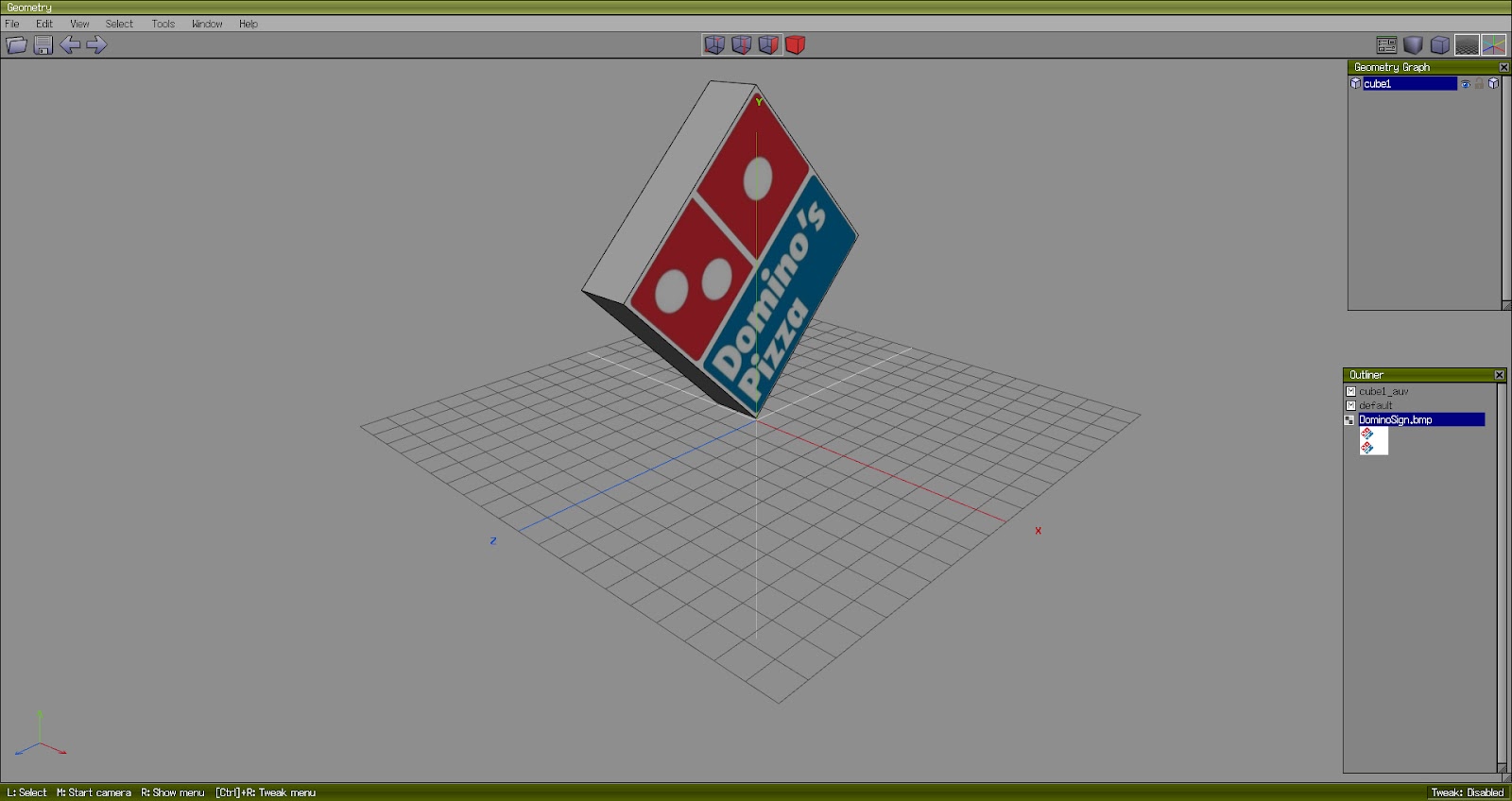
Finally, after adding this mesh into Niven.cfg:

(Click on images to enlarge)
THIS ISN'T an update to my add-on, BTW. Above view is looking roughly south from the base.
2013/03/09
Comet C/2013 A1 (Siding Spring) and Mars
 |
| (Last updated 05/11/2013. Click on image to enlarge.) |
The screenshot above was generated using the freeware space simulation Orbiter. It depicts Comet C/2013 A1, aka Siding Spring, during its closest approach to Mars on October 19, 2014.
Also used to generate the above screenshot was the Horizons Web Interface, maintained by the Jet Propulsion Laboratory at the California Institute of Technology. I generated the ephemeris with this web interface, and then plugged the numbers into an Orbiter scenario.
There's only an observational arc of 211 days - so there WILL be a really decent fly by - with enough refinement to the projected orbit (for now) to say it WILL NOT hit Mars.
Per SpaceObs.org:
Since C/2013 A1 is a hyperbolic comet and moves in a retrograde orbit, its velocity with respect to the planet will be very high, approximately 56 km/s. With the current estimate of the absolute magnitude of the nucleus M2 = 10.3, which might indicate the diameter from 10 to 50 km, the energy of impact might reach the equivalent of staggering 2×10¹º megatonnes! This kind of event can leave a crater 500 km across and 2 km deep. Such an event would overshadow even the famous bombardment of Jupiter by the disintegrated comet Shoemaker–Levy 9 in July 1994, which by some estimates was originally 15 km in diameter.Stay tuned, Dear Reader (if any). As new observations over time refine the orbit of this comet, I plan to update the screenshot and/or post a short video derived from an Orbiter scenario.
Edit:
A short video:
2012/09/12
Rice Unverisity - 50 years
This is the speech President John F. Kennedy gave at Rice University 50 years ago today. I point this out mainly because I morphed a quotation from it into my Orbiter motto. Also, because he touched upon the idea of American exceptionalism...a quaint idea that has fallen by the wayside since.
Full credit to the John F. Kennedy Presidential Library.
Added emphasis is mine.
Full credit to the John F. Kennedy Presidential Library.
Added emphasis is mine.
President Pitzer, Mr. Vice President, Governor, Congressman Thomas, Senator Wiley, and Congressman Miller, Mr. Webb, Mr. Bell, scientists, distinguished guests, and ladies and gentlemen:
I appreciate your president having made me an honorary visiting professor, and I will assure you that my first lecture will be very brief.
I am delighted to be here and I'm particularly delighted to be here on this occasion.
We meet at a college noted for knowledge, in a city noted for progress, in a State noted for strength, and we stand in need of all three, for we meet in an hour of change and challenge, in a decade of hope and fear, in an age of both knowledge and ignorance. The greater our knowledge increases, the greater our ignorance unfolds.Despite the striking fact that most of the scientists that the world has ever known are alive and working today, despite the fact that this Nation¹s own scientific manpower is doubling every 12 years in a rate of growth more than three times that of our population as a whole, despite that, the vast stretches of the unknown and the unanswered and the unfinished still far outstrip our collective comprehension.No man can fully grasp how far and how fast we have come, but condense, if you will, the 50,000 years of man¹s recorded history in a time span of but a half a century. Stated in these terms, we know very little about the first 40 years, except at the end of them advanced man had learned to use the skins of animals to cover them. Then about 10 years ago, under this standard, man emerged from his caves to construct other kinds of shelter. Only five years ago man learned to write and use a cart with wheels. Christianity began less than two years ago. The printing press came this year, and then less than two months ago, during this whole 50-year span of human history, the steam engine provided a new source of power.Newton explored the meaning of gravity. Last month electric lights and telephones and automobiles and airplanes became available. Only last week did we develop penicillin and television and nuclear power, and now if America¹s new spacecraft succeeds in reaching Venus, we will have literally reached the stars before midnight tonight.This is a breathtaking pace, and such a pace cannot help but create new ills as it dispels old, new ignorance, new problems, new dangers. Surely the opening vistas of space promise high costs and hardships, as well as high reward.So it is not surprising that some would have us stay where we are a little longer to rest, to wait. But this city of Houston, this State of Texas, this country of the United States was not built by those who waited and rested and wished to look behind them. This country was conquered by those who moved forward--and so will space.William Bradford, speaking in 1630 of the founding of the Plymouth Bay Colony, said that all great and honorable actions are accompanied with great difficulties, and both must be enterprised and overcome with answerable courage.If this capsule history of our progress teaches us anything, it is that man, in his quest for knowledge and progress, is determined and cannot be deterred. The exploration of space will go ahead, whether we join in it or not, and it is one of the great adventures of all time, and no nation which expects to be the leader of other nations can expect to stay behind in the race for space.Those who came before us made certain that this country rode the first waves of the industrial revolutions, the first waves of modern invention, and the first wave of nuclear power, and this generation does not intend to founder in the backwash of the coming age of space. We mean to be a part of it--we mean to lead it. For the eyes of the world now look into space, to the moon and to the planets beyond, and we have vowed that we shall not see it governed by a hostile flag of conquest, but by a banner of freedom and peace. We have vowed that we shall not see space filled with weapons of mass destruction, but with instruments of knowledge and understanding.Yet the vows of this Nation can only be fulfilled if we in this Nation are first, and, therefore, we intend to be first. In short, our leadership in science and in industry, our hopes for peace and security, our obligations to ourselves as well as others, all require us to make this effort, to solve these mysteries, to solve them for the good of all men, and to become the world's leading space-faring nation.We set sail on this new sea because there is new knowledge to be gained, and new rights to be won, and they must be won and used for the progress of all people. For space science, like nuclear science and all technology, has no conscience of its own. Whether it will become a force for good or ill depends on man, and only if the United States occupies a position of pre-eminence can we help decide whether this new ocean will be a sea of peace or a new terrifying theater of war. I do not say the we should or will go unprotected against the hostile misuse of space any more than we go unprotected against the hostile use of land or sea, but I do say that space can be explored and mastered without feeding the fires of war, without repeating the mistakes that man has made in extending his writ around this globe of ours.There is no strife, no prejudice, no national conflict in outer space as yet. Its hazards are hostile to us all. Its conquest deserves the best of all mankind, and its opportunity for peaceful cooperation many never come again. But why, some say, the moon? Why choose this as our goal? And they may well ask why climb the highest mountain? Why, 35 years ago, fly the Atlantic? Why does Rice play Texas?We choose to go to the moon. We choose to go to the moon in this decade and do the other things, not because they are easy, but because they are hard, because that goal will serve to organize and measure the best of our energies and skills, because that challenge is one that we are willing to accept, one we are unwilling to postpone, and one which we intend to win, and the others, too.It is for these reasons that I regard the decision last year to shift our efforts in space from low to high gear as among the most important decisions that will be made during my incumbency in the office of the Presidency.In the last 24 hours we have seen facilities now being created for the greatest and most complex exploration in man's history. We have felt the ground shake and the air shattered by the testing of a Saturn C-1 booster rocket, many times as powerful as the Atlas which launched John Glenn, generating power equivalent to 10,000 automobiles with their accelerators on the floor. We have seen the site where five F-1 rocket engines, each one as powerful as all eight engines of the Saturn combined, will be clustered together to make the advanced Saturn missile, assembled in a new building to be built at Cape Canaveral as tall as a 48 story structure, as wide as a city block, and as long as two lengths of this field.Within these last 19 months at least 45 satellites have circled the earth. Some 40 of them were "made in the United States of America" and they were far more sophisticated and supplied far more knowledge to the people of the world than those of the Soviet Union.The Mariner spacecraft now on its way to Venus is the most intricate instrument in the history of space science. The accuracy of that shot is comparable to firing a missile from Cape Canaveral and dropping it in this stadium between the the 40-yard lines.Transit satellites are helping our ships at sea to steer a safer course. Tiros satellites have given us unprecedented warnings of hurricanes and storms, and will do the same for forest fires and icebergs.We have had our failures, but so have others, even if they do not admit them. And they may be less public.To be sure, we are behind, and will be behind for some time in manned flight. But we do not intend to stay behind, and in this decade, we shall make up and move ahead.The growth of our science and education will be enriched by new knowledge of our universe and environment, by new techniques of learning and mapping and observation, by new tools and computers for industry, medicine, the home as well as the school. Technical institutions, such as Rice, will reap the harvest of these gains.And finally, the space effort itself, while still in its infancy, has already created a great number of new companies, and tens of thousands of new jobs. Space and related industries are generating new demands in investment and skilled personnel, and this city and this State, and this region, will share greatly in this growth. What was once the furthest outpost on the old frontier of the West will be the furthest outpost on the new frontier of science and space. Houston, your City of Houston, with its Manned Spacecraft Center, will become the heart of a large scientific and engineering community. During the next 5 years the National Aeronautics and Space Administration expects to double the number of scientists and engineers in this area, to increase its outlays for salaries and expenses to $60 million a year; to invest some $200 million in plant and laboratory facilities; and to direct or contract for new space efforts over $1 billion from this Center in this City.To be sure, all this costs us all a good deal of money. This year¹s space budget is three times what it was in January 1961, and it is greater than the space budget of the previous eight years combined. That budget now stands at $5,400 million a year--a staggering sum, though somewhat less than we pay for cigarettes and cigars every year. Space expenditures will soon rise some more, from 40 cents per person per week to more than 50 cents a week for every man, woman and child in the United Stated, for we have given this program a high national priority--even though I realize that this is in some measure an act of faith and vision, for we do not now know what benefits await us. But if I were to say, my fellow citizens, that we shall send to the moon, 240,000 miles away from the control station in Houston, a giant rocket more than 300 feet tall, the length of this football field, made of new metal alloys, some of which have not yet been invented, capable of standing heat and stresses several times more than have ever been experienced, fitted together with a precision better than the finest watch, carrying all the equipment needed for propulsion, guidance, control, communications, food and survival, on an untried mission, to an unknown celestial body, and then return it safely to earth, re-entering the atmosphere at speeds of over 25,000 miles per hour, causing heat about half that of the temperature of the sun--almost as hot as it is here today--and do all this, and do it right, and do it first before this decade is out--then we must be bold.I'm the one who is doing all the work, so we just want you to stay cool for a minute. [laughter]However, I think we're going to do it, and I think that we must pay what needs to be paid. I don't think we ought to waste any money, but I think we ought to do the job. And this will be done in the decade of the sixties. It may be done while some of you are still here at school at this college and university. It will be done during the term of office of some of the people who sit here on this platform. But it will be done. And it will be done before the end of this decade.I am delighted that this university is playing a part in putting a man on the moon as part of a great national effort of the United States of America.Many years ago the great British explorer George Mallory, who was to die on Mount Everest, was asked why did he want to climb it. He said, "Because it is there."Well, space is there, and we're going to climb it, and the moon and the planets are there, and new hopes for knowledge and peace are there. And, therefore, as we set sail we ask God's blessing on the most hazardous and dangerous and greatest adventure on which man has ever embarked.Thank you.
2012/08/26
One Small Step

Photo credit: Donamy
Oh! I have slipped the surly bonds of earth,
And danced the skies on laughter-silvered wings;
Sunward I’ve climbed, and joined the tumbling mirth
Of sun-split clouds, –and done a hundred things
You have not dreamed of –Wheeled and soared and swung
High in the sunlit silence. Hov’ring there
I’ve chased the shouting wind along, and flung
My eager craft through footless halls of air…
Up, up the long, delirious, burning blue
I’ve topped the wind-swept heights with easy grace
Where never lark or even eagle flew —
And, while with silent lifting mind I’ve trod
The high untrespassed sanctity of space,
Put out my hand, and touched the face of God.
John Gillespie Magee, Jr
Since Neil was initially trained as a Naval aviator, he also deserves a Missing Man:

Photo credit: Star Voyager
Now for the really boring part, Dear Reader (if any). I still remember watching the first "small step" live on TV. I was watching it with my father (another boyhood hero who is now gone), and he was trimming my fingernails.
UPDATED SEPTEMBER 1, 2012:
Missing Man formation flown for Neil at his memorial on August 31, 2012:
 Photo Credit: NASA
Then there was two:
 Photo Credit: NASA
Oh! I have slipped the surly bonds of earth,
And danced the skies on laughter-silvered wings;
Sunward I’ve climbed, and joined the tumbling mirth
Of sun-split clouds, –and done a hundred things
You have not dreamed of –Wheeled and soared and swung
High in the sunlit silence. Hov’ring there
I’ve chased the shouting wind along, and flung
My eager craft through footless halls of air…
Up, up the long, delirious, burning blue
I’ve topped the wind-swept heights with easy grace
Where never lark or even eagle flew —
And, while with silent lifting mind I’ve trod
The high untrespassed sanctity of space,
Put out my hand, and touched the face of God.
John Gillespie Magee, Jr
I’ve chased the shouting wind along, and flung
My eager craft through footless halls of air…
Up, up the long, delirious, burning blue
I’ve topped the wind-swept heights with easy grace
Where never lark or even eagle flew —
And, while with silent lifting mind I’ve trod
The high untrespassed sanctity of space,
Put out my hand, and touched the face of God.
John Gillespie Magee, Jr
Since Neil was initially trained as a Naval aviator, he also deserves a Missing Man:
Photo credit: Star Voyager
Now for the really boring part, Dear Reader (if any). I still remember watching the first "small step" live on TV. I was watching it with my father (another boyhood hero who is now gone), and he was trimming my fingernails.
UPDATED SEPTEMBER 1, 2012:
Missing Man formation flown for Neil at his memorial on August 31, 2012:
Photo Credit: NASA
Then there was two:
Photo Credit: NASA
UPDATED SEPTEMBER 1, 2012:
Missing Man formation flown for Neil at his memorial on August 31, 2012:
Then there was two:

2012/06/10
Earth at Night
I can't help but contemplate about Psalm 115:16 when I watch this video:
A family member once opined that humans have no business in space per the Dominion Mandate and the above Psalm.
Per this reasoned article on the matter, I think otherwise.
A family member once opined that humans have no business in space per the Dominion Mandate and the above Psalm.
Per this reasoned article on the matter, I think otherwise.
2012/03/16
Riding the Boosters
I'll let the video speak for itself. Special thanks to Skywalker Sound.
Hat tip to Bob DeLong.
Hat tip to Bob DeLong.
2012/02/20
50 years - Friendship 7 - John Glenn

Dear reader (if any), do you really think I'd let this anniversary go by without comment or observation? I was exactly 2 weeks old as of February 20, 1962. That puts my conception on or about May 2, 1961. See here for events on May 5, 1961. I am a child of the Space Age/Race.
John Glenn's Mission Patch:

For the official NASA "take" on the mission, go here.
A nice take on the subject by Space.com:
(Sorry for the tiny embed...blame Space.com. Direct link here)
My take on it:
(Caution...this is where I assume most will fall asleep due to sheer boredom. Be glad I got the more exciting stuff out of the way first)
My favorite GI Joe "action figure" (yes, I played with "dolls" too) was the Mercury astronaut complete with the Mercury spacecraft. I remember taking that to 3rd grade for show and tell, along with the "nifty" vacuum formed record of the Friendship 7 flight audio.
For years, I spelled my middle name with 2 "n", thinking my parents named me after Mr. Glenn. I found out at the "tender" age of 12 this wasn't so after seeing my birth certificate and getting my first Social Security card while in 6th grade. I also developed myopia at the same time, thus disqualifying me from being a test pilot and hence an astronaut. I decided then if I couldn't fly them, I'd design them. Plan B (aerospace engineering, or "rocket scientist") didn't pan out either, BTW.
The most successful college paper I wrote was on Beowulf, on the thesis of the single combatant warrior. But actually, I got that idea from Tom Wolfe's, The Right Stuff. Mr. Wolfe's fantastic observation was that the Mercury astronauts were dueling it out on the Nation's behalf against the Soviets.
I also remember how cheesy and derivative it was when Sen. Glenn(D-OH) finagled a ride on STS-95 (10/29/98 to 11/7/98). I say derivative because Sen. Garn(R-UT) finagled a ride on STS-51d (4/12 to 4/19/85). Yet this did show me another way into space...just become rich - be elected to the U.S. Senate - and get on the right committee to start twisting arms.
2012/01/07
Lunar Base Niven 2012 updates
I finally had enough time and ambition to start adding the finishing touches to my Orbiter add-on surface base, Lunar Base Niven. As of now, I've been working about 3 weeks on it, and estimate another 3-4 weeks before it is done.
I've animated portions of the domes and the doors on the surface locks. I've added UCGO surface vehicles programmed to visit the outer laying portions of the base (the nuclear power plant, the VLA antennas, and the solar power panel farms). I've also added UMmu breathable areas to the domes and locks.
Why the name Niven? I choose it as a tribute to one of my top five science fiction authors, Larry Niven. I would have choosen Heinlein...but it was already taken.
Here's 2 screen shots, both from the same position. Remember, dear Reader (if any), click on any of the images to enlarge/download.
During lunar day:
 During lunar night:

As stated in the original documentation:

I've animated portions of the domes and the doors on the surface locks. I've added UCGO surface vehicles programmed to visit the outer laying portions of the base (the nuclear power plant, the VLA antennas, and the solar power panel farms). I've also added UMmu breathable areas to the domes and locks.
Why the name Niven? I choose it as a tribute to one of my top five science fiction authors, Larry Niven. I would have choosen Heinlein...but it was already taken.
Here's 2 screen shots, both from the same position. Remember, dear Reader (if any), click on any of the images to enlarge/download.
During lunar day:


As stated in the original documentation:
Most of the structures are like icebergs with most of the volume below the surface in order to provide shielding against the occasional solar flare and coronal mass ejection. Each dome is actually a sphere with a diameter of 110 meters. Volume of each is 641,431 m3, which gives the entire habitat complex a total volume of 5.8 million m3. This is about 5 times the size of the Pentagon, or, about 2 times the size of the World Trade Center.Here's a graphic of the entire base, as published in the original release:

2011/09/18
UARS and Chicken Little
Yes...the sky is falling!
Actually, just UARS (Upper Atmosphere Research Satellite). But NASA is predicting only 1 in 3200 chance that a part of it will hit a person. With an orbital inclination of 57 degrees, UARS will reenter and parts of it will strike somewhere between 57 deg north latitude and 57 deg south latitude. Which covers most of the inhabited surface of Earth...but there's a lot of ocean in that zone as well.
Launched on 09/12/1991, it was designed to study Earth's atmosphere, particularly the ozone layer. The original mission life was 3 years, and finally decommissioned in 2005 with a de-orbit burn (using up all of its fuel) in December '05. Since then, it has been slowly spiraling down and latest estimates put reentry happening on September 23, 2011...plus/minus a day. Dear reader, (if any), may back check facts here and here.

Source: SPACE.com: All about our solar system, outer space and exploration
NASA's ORSAT Orbital debris projection: (pay attention to the parts with a Demise Altitude of 0 km).

Wait for it....now, the Orbiter angle.
A fellow Orbinaut was smart enough to post simulation scenarios for UARS in this thread at O-F. Note that the scenario was created with and intended for ver 2010P1 of Orbiter. I downloaded and ran this just for grins and giggles. My simulation run predicts that Australia (somewhere SW of Brisbane) will get hammered with the debris...again! I say again, because another piece of US space hardware, Skylab, managed to shower the Aussies with pieces of itself back in July of 1979. Apparently, the Shire of Esperance fined the United States $400 for littering, a fine which remained unpaid for 30 years.
Here is a screen shot of my sim run (click on image to enlarge):

And a screen shot from Google Earth (click on image to enlarge):

Or visit my web site to download the *.kmz file (UARS Demise) and open that file with Google Earth.
How's this for synchronicity?
The first time I started the scenario with Orbiter, my mp3 play list within Orbiter started playing "Re-Entry" from In the Shadow of the Moon soundtrack.
Rather fitting, and spooky at the same time.
Actually, just UARS (Upper Atmosphere Research Satellite). But NASA is predicting only 1 in 3200 chance that a part of it will hit a person. With an orbital inclination of 57 degrees, UARS will reenter and parts of it will strike somewhere between 57 deg north latitude and 57 deg south latitude. Which covers most of the inhabited surface of Earth...but there's a lot of ocean in that zone as well.
Launched on 09/12/1991, it was designed to study Earth's atmosphere, particularly the ozone layer. The original mission life was 3 years, and finally decommissioned in 2005 with a de-orbit burn (using up all of its fuel) in December '05. Since then, it has been slowly spiraling down and latest estimates put reentry happening on September 23, 2011...plus/minus a day. Dear reader, (if any), may back check facts here and here.
Source: SPACE.com: All about our solar system, outer space and exploration
NASA's ORSAT Orbital debris projection: (pay attention to the parts with a Demise Altitude of 0 km).
Wait for it....now, the Orbiter angle.
A fellow Orbinaut was smart enough to post simulation scenarios for UARS in this thread at O-F. Note that the scenario was created with and intended for ver 2010P1 of Orbiter. I downloaded and ran this just for grins and giggles. My simulation run predicts that Australia (somewhere SW of Brisbane) will get hammered with the debris...again! I say again, because another piece of US space hardware, Skylab, managed to shower the Aussies with pieces of itself back in July of 1979. Apparently, the Shire of Esperance fined the United States $400 for littering, a fine which remained unpaid for 30 years.
Here is a screen shot of my sim run (click on image to enlarge):

And a screen shot from Google Earth (click on image to enlarge):

Or visit my web site to download the *.kmz file (UARS Demise) and open that file with Google Earth.
How's this for synchronicity?
The first time I started the scenario with Orbiter, my mp3 play list within Orbiter started playing "Re-Entry" from In the Shadow of the Moon soundtrack.
Rather fitting, and spooky at the same time.
2011/09/06
Better Photos of Apollo Landing Sites
One simply has to go to NASA's LRO (Lunar Reconnaissance Orbiter) website to see the interactive photos of Apollo 12, 14, and 17 landing sites. A slider in the middle of the photo lets you seen the difference between the previous photos and the most recent ones. Absolutely outstanding detail! At Apollo 17's landing site, you can see better the difference between the footprints the astronauts made and the tracks made by the lunar rover.
The official NASA press release can be found here.
Here's a You Tube video:
TAKE THAT YOU MOON LANDING HOAX NUT CASES!
As an inside joke, someone posted the following thread on Orbiter-Forum:
NASA releases photos of lunar landing sound-stage
The official NASA press release can be found here.
Here's a You Tube video:
TAKE THAT YOU MOON LANDING HOAX NUT CASES!
As an inside joke, someone posted the following thread on Orbiter-Forum:
NASA releases photos of lunar landing sound-stage
2011/08/28
2011/08/07
Apollo 11 Descent of Eagle to Landing via Google Moon
The video intro explains how this was constructed.
The best comment, IMO, was, "Yes they did".
The best comment, IMO, was, "Yes they did".
2011/07/30
Apollo 15 - 40 years
Yes, it is anniversary announcement time again.
Apollo 15 flew 40 years ago, from July 26, 1971 to August 7, 1971. It still remains my favorite mission of the Apollo series - and my scenario pack for this mission was my first Orbiter add-on.
It was the only mission I witnessed on TV from beginning to end. That was because it happened in the summer during school break between 3rd and 4th grades.
This date mission event was lunar landing at 6:16:29 PM EDT on July 30, 1971.
Mission firsts:

Jim Irwin remains the only astronaut I've seen in person. He visited his high school alma mater to speak to the student body.
Apollo 15 flew 40 years ago, from July 26, 1971 to August 7, 1971. It still remains my favorite mission of the Apollo series - and my scenario pack for this mission was my first Orbiter add-on.
It was the only mission I witnessed on TV from beginning to end. That was because it happened in the summer during school break between 3rd and 4th grades.
This date mission event was lunar landing at 6:16:29 PM EDT on July 30, 1971.
Mission firsts:
- First mission to use the Lunar Rover.
- First and only mission to incorporate a SEVA (Standing Extra Vehicular Activity).
- First mission to demonstrate a "Mr. Wizard" moment, i.e., dropping of the hammer and feather in vacuum.
- First all Air Force derived crew
- First deployment of a satellite while in lunar orbit.
- First EVA performed between Earth and Moon.
- First and only graduate of East High School (in SLC, UT) to walk on the Moon. See photo below.
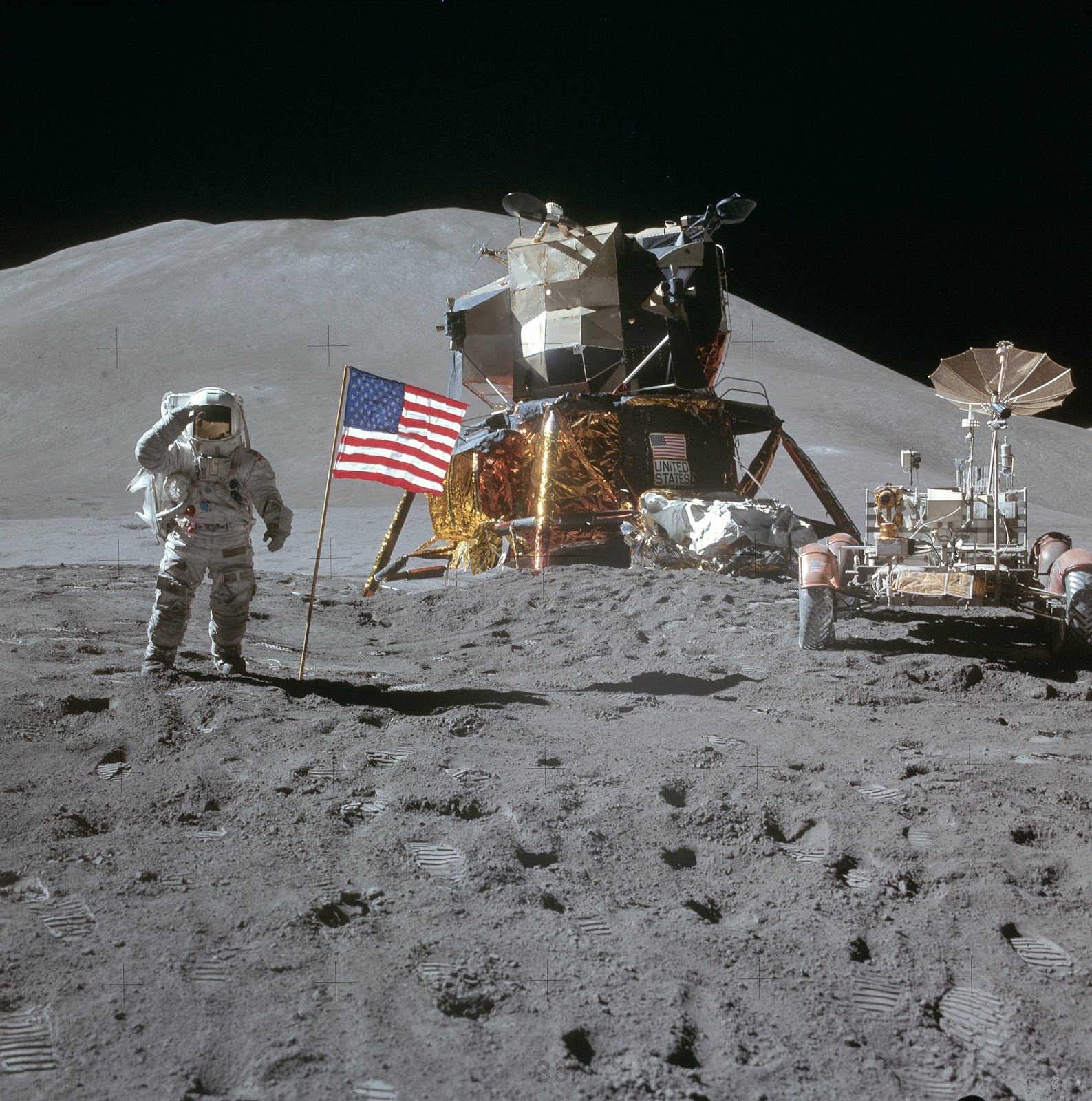
Courtesy of NASA. Photo of Jim Irwin saluting the flag.
Jim Irwin remains the only astronaut I've seen in person. He visited his high school alma mater to speak to the student body.
2011/05/25
Before The Decade Is Out
No politics or editorials today...just wanted to mark this anniversary.
50 years ago today, President John F. Kennedy made a speech before a joint session of Congress asking for more money for various things...including what eventually became the Apollo program.
Excerpt from the speech, credit to the JFK Presidential Library:
Click here for the full text of the speech.
50 years ago today, President John F. Kennedy made a speech before a joint session of Congress asking for more money for various things...including what eventually became the Apollo program.
Excerpt from the speech, credit to the JFK Presidential Library:
Finally, if we are to win the battle that is now going on around the world between freedom and tyranny, the dramatic achievements in space which occurred in recent weeks should have made clear to us all, as did the Sputnik in 1957, the impact of this adventure on the minds of men everywhere, who are attempting to make a determination of which road they should take. Since early in my term, our efforts in space have been under review. With the advice of the Vice President, who is Chairman of the National Space Council, we have examined where we are strong and where we are not, where we may succeed and where we may not. Now it is time to take longer strides--time for a great new American enterprise--time for this nation to take a clearly leading role in space achievement, which in many ways may hold the key to our future on earth.(Emphasis mine)
I believe we possess all the resources and talents necessary. But the facts of the matter are that we have never made the national decisions or marshalled the national resources required for such leadership. We have never specified long-range goals on an urgent time schedule, or managed our resources and our time so as to insure their fulfillment.
Recognizing the head start obtained by the Soviets with their large rocket engines, which gives them many months of leadtime, and recognizing the likelihood that they will exploit this lead for some time to come in still more impressive successes, we nevertheless are required to make new efforts on our own. For while we cannot guarantee that we shall one day be first, we can guarantee that any failure to make this effort will make us last. We take an additional risk by making it in full view of the world, but as shown by the feat of astronaut Shepard, this very risk enhances our stature when we are successful. But this is not merely a race. Space is open to us now; and our eagerness to share its meaning is not governed by the efforts of others. We go into space because whatever mankind must undertake, free men must fully share.
I therefore ask the Congress, above and beyond the increases I have earlier requested for space activities, to provide the funds which are needed to meet the following national goals:
First, I believe that this nation should commit itself to achieving the goal, before this decade is out, of landing a man on the moon and returning him safely to the earth. No single space project in this period will be more impressive to mankind, or more important for the long-range exploration of space; and none will be so difficult or expensive to accomplish. We propose to accelerate the development of the appropriate lunar space craft. We propose to develop alternate liquid and solid fuel boosters, much larger than any now being developed, until certain which is superior. We propose additional funds for other engine development and for unmanned explorations--explorations which are particularly important for one purpose which this nation will never overlook: the survival of the man who first makes this daring flight. But in a very real sense, it will not be one man going to the moon--if we make this judgment affirmatively, it will be an entire nation. For all of us must work to put him there.
Click here for the full text of the speech.
2011/05/15
My Orbiter Life

When I first found Orbiter in March 2006, I was then playing with Eagle Lander 3D (which could only simulate the Apollo lunar missions - and only those portions that happened in lunar orbit), I was elated that I could fully simulate an entire Apollo mission. As my 1st blog entry states, "I was hopelessly hooked".
I have spent most of my life being aware that most of the other people around me aren't as smart - certainly not rocket scientist smart. I had to learn at an early age to recognize that "deer in the headlights" stare in other's eyes when I got too zealous or detailed in my descriptions of the way shit works...and dial it back a little at times. Then I found the Orbiter community...and now I feel I've found home.
Since finding Orbiter, I've tried sharing it with friends and co-workers, and have only found one interested enough to even try it. Orbiter isn't the first topic, but I bring it up when the person has related that he enjoys video games and is extremely computer literate.
Simulations, as a genre, aren't all that popular with most gamers because, IMO, there's a learning curve (or too steep), too much detail...etc. It is though most of them suffer, IMO, from some degree of AADD. Or, they shirk from the realization that they actually have to "plan" something to achieve goals.
The one person who even tried it, while growing up, was the first of my son's friends to get the latest and greatest gaming console as soon as they hit the market. This person also showed early aptitude with computers and is very gifted musically too. By the time he asked me for help with an Orbiter scenario, he had successfully gotten the stock DG into orbit. Reference here or here. He stayed with Orbiter another week or two...he didn't quite get how to set up a orbital rendezvous with another spacecraft, so it lost interest for him. I haven't bother to bring up that topic with him anymore...some people just aren't cut out for it.
As far as what others think of Orbiter...I don't really care. We're all blessed with different talents...THIS ONE IS MINE.
Interactive Scale of the Universe
Though I don't agree with the theoretical conclusion at the extreme large end of the scale, nevertheless, it is neat enough and "geeky" enough to mention here.
http://primaxstudio.com/stuff/scale_of_universe/index.php
Hat tip to Mister Kite for posting this on Orbiter-Forum.
http://primaxstudio.com/stuff/scale_of_universe/index.php
Hat tip to Mister Kite for posting this on Orbiter-Forum.
2011/05/05
50 Years of American Spaceflight

Today marks the 50th anniversary of Alan B. Shepard's sub-orbital flight aboard Freedom 7. The "ride" only lasted 15 minutes and 22 seconds, and reached a height of 116.46 miles. As his flight was the first to follow international rules, I decided not to mention in this blog the one that happened about 3 weeks earlier. OK, I'll admit I'm biased...the earlier flight wasn't American. Freedom 7 had been scheduled to fly 1 month earlier, but NASA wanted to perform more testing (yes, that's right, we sent another chimp up first), thus losing another round in the Space Race.
Yesterday, the U.S. Postal Service released two new stamps commemorating 2 flights spanning this time period. Shepard is the first astronaut to appear by himself on a stamp:

This video from NASA honors today's achievement, and includes comments from 2 of his Mercury colleagues:
Shepard was the only astronaut of the original seven selected by NASA to go on and make a moon landing as commander of Apollo 14. He also was the first to play golf on the Moon, on Feb. 6, 1971 (my ninth birthday).
Miles and miles and miles...
Subscribe to:
Posts (Atom)